
4.6. Empowering students to grow from their own experience

Tips on providing students with feedback
when they have failed at something
Do’s
- Feedback should be about behaviour not personality
- Feedback should describe the effect and impact of the person’s behaviour/ situation
- Give praise where praise is due
- Work on the positive aspects to build strengths and relevance of the student (everything you give attention to, grows)
- Ensure criticism is a positive enabling statement so that the recipient feels empowered to implement improvements.
- Display appropriate body language, especially in terms of eye contact, body positioning and physical mannerisms.
- Be specific about the good behaviours and be non-judgemental.
- Mutually explore and possibly offer suggestions or options for improvement or change.
Don’ts
- Avoid sarcasm and demeaning comments.
- Avoid blaming the individual with aggressive ’you’ statements.
- Avoid too much attention or importance to the negative aspects
- Avoid being judgemental
- Don’t finish on a negative mood
- Avoid generalising or using other people’s opinions (focus on your relationship and opinions)
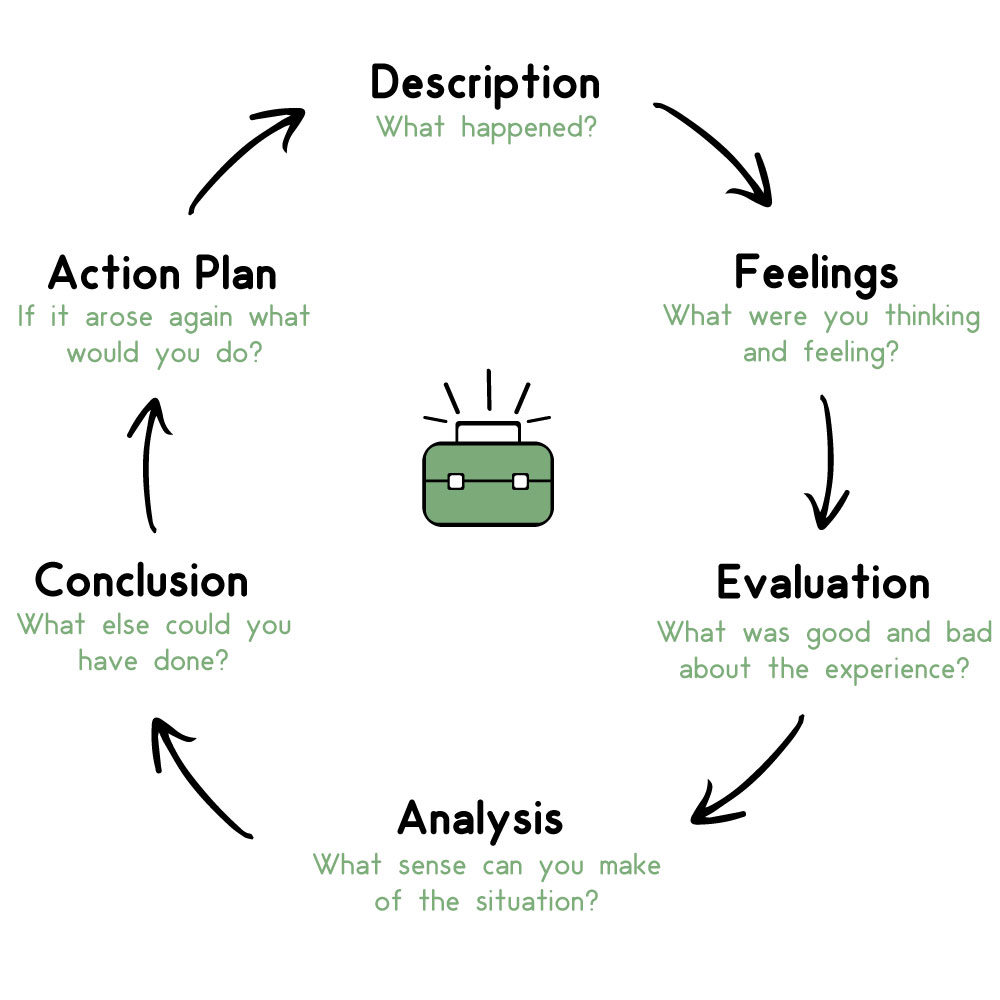
Getting feedback is important both for the student and the coach. It is important that they both reflect on what they have heard and agree on how to use it. Gibbs’ reflective cycle encourages you to think systematically about the phases of an experience or activity, and you should use all the headings to structure your reflection. The Six Stages of the Gibbs Reflective Cycle are:
- Description: Provide a factual account of the critical incident or chosen episode, describing what occurred without interpretation or judgment.
- Feelings: Reflect on the emotions and thoughts you experienced during the incident. Explore your personal reactions and consider how they influenced your actions.
- Evaluation: Assess the positive and negative aspects of the experience. List the strengths and weaknesses, highlighting what went well and what could have been improved.
- Analysis: Examine the situation in-depth to gain a deeper understanding. Analyze the factors that contributed to the outcome and consider any underlying causes or patterns.
- Conclusion: Reflect on alternative actions that could have been taken. Identify what you might have done differently and acknowledge any actions or decisions that were not effective.
Action Plan: Based on your reflection, develop an action plan for future similar situations. Determine how you will modify your approach or practice to incorporate the lessons learned from this reflection. Consider specific changes or improvements you will make to enhance your future performance.
Having learned from experience, it is then to put in place actions to move forward. The following 3 step problem solving model focuses on (1) exploring the problem or concern (Listening), (2) helping the student to develop a new understanding of the problem (Goal setting) and (3) helping the student to act to resolve the problem (Solving). Using this model will support the student in solving a problem, for example recognize his/her baggage, decide on steps/goals on how to overcome negative baggage and take the needed steps to overcome negative baggage.
A three-stage model (From Gerard Egan: The Skilled helper)
Stage 1
Exploration
The coach, by developing a warm relationship, enables the student to explore the problem from his or her ‘frame of reference’ and focus on specific concerns.
Skills
Giving attention, Listening, Paraphrasing, Reflecting, Focusing and Summarising
Stage 2
New understanding
The student is helped to see themselves and their situation in new perspectives and focus on what they might do to cope more effectively. They are helped to see what is going right or wrong in their situation, what strengths and resources they might use, what ‘blind spots’ may hinder them from managing their problems.
Skills
All the skills of Stage 1 plus:
- Asking questions
- Helping the student to recognise themes and inconsistencies
- Giving information
- Self-disclosure
- Challenging the student
- Goal-setting
Stage 3
Taking action
Having clarified a goal or goals, the student is helped to consider possible ways of acting, to look at costs and consequences, to plan action, to implement it and to evaluate progress.
Skills
All the skills of Stage 1 and 2 plus:
Creative-thinking Problem-solving Planning action Evaluation
The model is not a ‘straitjacket’, a rigid scheme to stick to at all costs. Students are not always going to move smoothly from one stage to another. Often it is necessary to re-trace steps, e.g. if the action doesn’t work out (Stage 3) it might be necessary to go back to Stage 2 or Stage 1.
In reality, people who are unhappy with their situation (Stage 1) often jump straight to Stage 3 (taking action) without establishing goals (Stage 2). Sometimes doing almost anything is seen by the person as better than remaining at Stage 1. Then impulsively acting often simply creates further problems. The intention of the model is to help coaches and mentors work with students to really work through problems, establish goals and then take action. In this case the action is more likely to help to resolve the problem.